ML4CPD
Machine learning for cryogenic particle detectors (ML4CPD) is a project funded by the industrial PhD program of the Austrian research promotion agency for the years 2020–2023. In the course of this project we are building machine learning methods to automate data analysis and control of cryogenic calorimeters that are used by the CRESST and COSINUS experiments for the direct detection of dark matter. Below I highlight some pieces of the scientific output of our project.
Cait — Analysis Toolkit for Cryogenic Particle Detectors
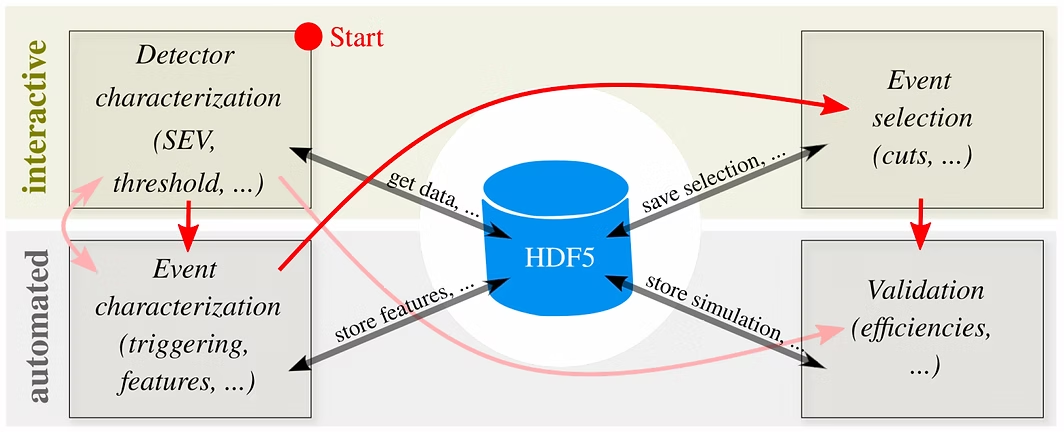
Cryogenic solid state detectors are widely used in dark matter and neutrino experiments, and require a sensible raw data analysis. For this purpose, we present Cait, an open source Python package with all essential methods for the analysis of detector modules fully integrable with the Python ecosystem for scientific computing and machine learning. It comes with methods for triggering of events from continuously sampled streams, identification of particle recoils and artifacts in a low signal-to-noise ratio environment, the reconstruction of deposited energies, and the simulation of a variety of typical event types. Furthermore, by connecting Cait with existing machine learning frameworks we introduce novel methods for better automation in data cleaning and background rejection.
Cait was published in the CSBS journal (Comput Softw Big Sci 6, 19) and is available on PyPI, Zenodo, ReadtheDocs and GitHub.
Towards Automated Data Cleaning with Deep Learning in CRESST
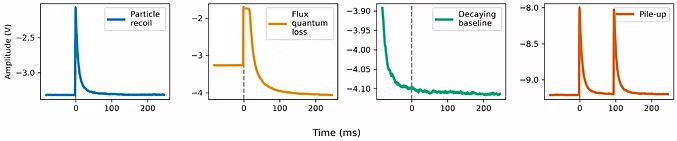
Our automated data cleaning work was published in EPJ+ (Eur. Phys. J. Plus 138, 100).
The signals recorded with cryogenic calorimeters need to undergo a careful cleaning process to avoid wrongly reconstructed recoil energies caused by pile-up and read-out artefacts. We frame this process as a time-series classification task and automate it with neural networks trained on more than one million labeled records from 68 CRESST detectors. The best model reaches a balanced accuracy of 0.932 and can provide fast, detector-independent quality cuts for large cryogenic detector arrays.
Optimal Operation of Cryogenic Calorimeters Through Deep Reinforcement Learning
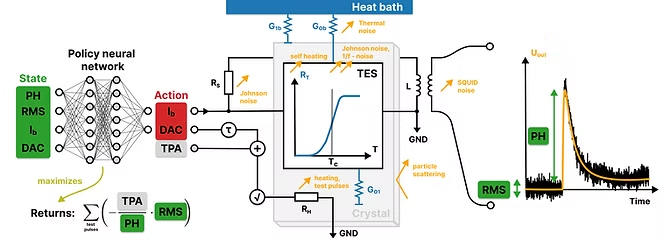
Our method for automated and optimal detector operation was presented at ACAT22 and published in 2024 (Comput Softw Big Sci 8, 10).
Cryogenic phonon detectors are used by direct detection dark matter experiments to achieve sensitivity to light dark matter particle interactions. Such detectors consist of a target crystal equipped with a superconducting thermometer. The temperature of the thermometer and the bias current in its readout circuit need careful optimization to achieve optimal sensitivity of the detector. This task is not trivial and has to be done manually by an expert. In our work, we created a simulation of the detector response as an OpenAI Gym reinforcement learning environment. In the simulation, we test the capability of a soft actor critic agent to perform the task. We accomplish the optimization of a standard detector in the equivalent of 30 minutes of real measurement time, which is faster than most human experts. Our method can improve the scalability of multi-detector setups.