Spin-dependent Dark Matter
In CRESST's latest major results paper (Phys. Rev. D 106, 092008) we describe world-leading limits on spin-dependent dark matter derived with two detectors with lithium aluminate targets.
Testing Spin-dependent Dark Matter Interactions with Lithium Aluminate Targets in CRESST-III
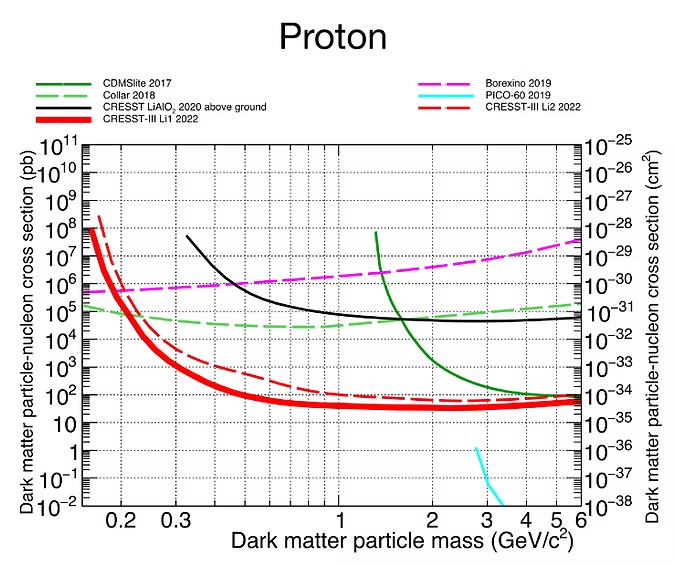
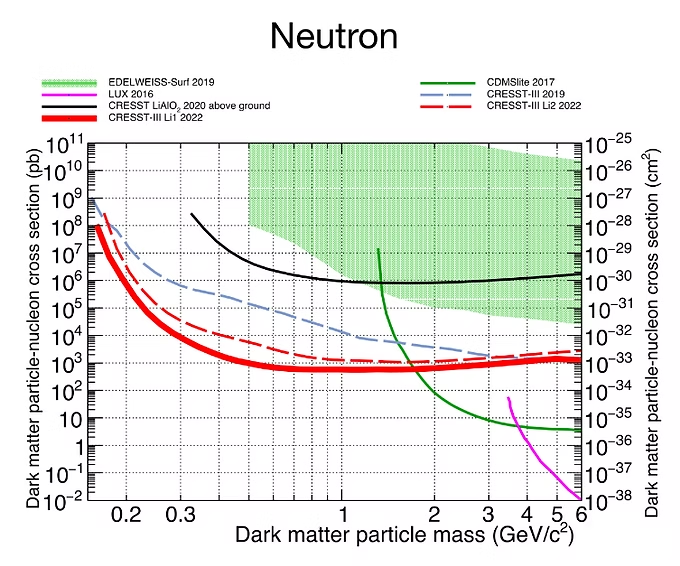
In the past decades, numerous experiments have emerged to unveil the nature of dark matter, one of the most discussed open questions in modern particle physics. Among them, the Cryogenic Rare Event Search with Superconducting Thermometers (CRESST) experiment, located at the Laboratori Nazionali del Gran Sasso, operates scintillating crystals as cryogenic phonon detectors.
In this work, we present first results from the operation of two detector modules which both have 10.46 g LiAlO₂ targets in CRESST-III. The lithium contents in the crystal are ⁶Li, with an odd number of protons and neutrons, and ⁷Li, with an odd number of protons. By considering both isotopes of lithium and ²⁷Al, we set the currently strongest cross section upper limits on spin-dependent interaction of dark matter with protons and neutrons for the mass region between 0.25 and 1.5 GeV/c².